
ABSTRACT
Pig farming has evolved has an economically important livestock enterprise that has contributed significantly to rural employment, income generation and nutritional security. This case study documents the successful establishment and management of a commercial pig farm owned by Mr. Subbareddy in Kaiwara village, Chintamani taluk, Chikkaballapur district, Karnataka. Mr. Subbareddy started the farm with only 20 pigs and now he has the unit to more than 600 pigs within the span of 3 years through practical experience, continuous learning and scientific management practices. The farm primarily rears exotic breeds such as Duroc and Landrace owing to their superior growth rate, feed conversion efficiency and carcass quality. The study highlights key production and management practices including breeding management, feeding strategies, piglet care, biosecurity measures, waste management, labour availability and market facilities. A cost-effective feeding system based on boiled hotel and vegetable waste, supplemented with concentrate feed, has reduced the production cost. strict biosecurity protocols, routine vaccination, deworming and sanitation practices has minimized disease incidence and mortality. Despite its success the farm faces several constraints , including limited government support, inadequate training opportunities ,marketing challenges and price fluctuations due to dependence on intermediaries .The farmer says that scientific management, patience ,practical knowledge and continuous learning are essential for profitable pig farming .This case study demonstrates that commercial pig farming can be a sustainable and profitable enterprise in Karnataka when supported by efficient management practices and improved institutional support.
KEY WORDS: Pig farming, Success story, Entrepreneur, Karnataka, Profitability.
INTRODUCTION
The domesticated pigs belong to genus Sus and species Sus scrofa domesticus. The history of domestication of pig’s dates back approximately 9,000 to 10,000 years ago originating in the region of Europe and China. Over time, pig farming has evolved from simple hunting and subsistence rearing practices into dynamically and economically significant agricultural enterprise. Today it has developed into a modern, scientifically managed industry incorporating advancements in genetics, nutrition, and animal welfare. Pig farming is an important branch of animal husbandry, encompassing the rearing, breeding and effective management of pigs. It plays a vital role in supporting the livelihoods of many individuals, particularly marginal and small-scale farmers. Furthermore, it contributes significantly to income generation, employment opportunities, and nutritional security, especially within rural areas.
SCENARIO OF PIG FARMING IN INDIA
In India, according to the 20th Livestock Census, the total pig population is approximately 9.06 million, comprising about 1.90 million exotic pigs and 7.16 million Indigenous pigs. Pigs contribute around 1.69% to the total livestock population and 3.6% to the country’s total meat production. However, a decline of 12.03% in the pig population has been observed as compared to the previous census. States with significant pig populations include Assam, Jharkhand and West Bengal. Karnataka ranks 9th with an approximate pig population of 3.2 lakh, making it one of the leading states in southern India in terms of pig rearing. (1)
THE SUCCESSFUL FARMER
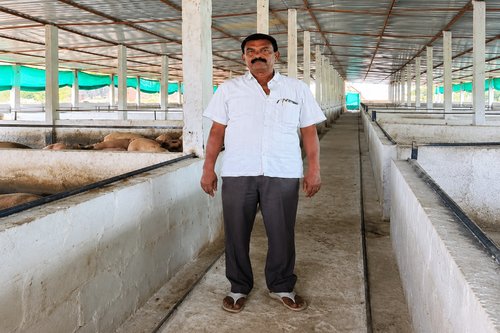
Many farmers across Karnataka have adopted pig farming as a major source of income, with a considerable number of people achieving success in this sector. Mr. Subbareddy (fig 1) S/o Late Gowdanavara chikkanarayanappa and late Dyavamma, a resident of Kaiwara village in Chintamani taluk of Chikkaballapura district, is one such successful farmer. Through consistent effort and dedication, he established a large-scale pig farm expanding his stock from just 20 pigs to over 600 pigs within a short span of three years.
INSPIRATION BEHIND THE ENTERPRISE
Mr. Subbareddy says that the idea for establishing the pig farm came from a visit to his relative’s farm. He is living proof that if one is interested in farming, they can do miracles in the field. Despite lacking formal training in the sector, his expertise was built entirely on hands-on practical experience, insights shared by fellow farmers, and self-guided learning from informal digital avenues like YouTube. The motivation behind his success lies in his strong interest, continuous learning and his dedication.
EXPANSION OF THE FARM
He has built his farm from the scratch from a small, old brick shed to a scientifically maintained pig house capable of housing 1000 pigs. The motivation behind his success lies in his strong interest, continuous learning and dedication to pig farming.
BREED PREFERENCE
According to the farmer Exotic breeds such as Duroc and Landrace are well suited for commercial production due to their superior performance. These breeds exhibit faster growth achieving market weight of 120–150 kg within approximately 9 months of age. Along with this, they demonstrate improved feed conversion efficiency, early sexual maturity, ability to produce 10–12 piglets per litter. They also provide better carcass quality, and more uniform growth. As a result, farmers can achieve higher profitability and meet stronger market demand.
BREEDING AND PREGNANT SOW MANAGEMENT
To facilitate breeding, both male and female breeding stocks are housed and maintained within a separate 0.5-acre breeder shed. Heat detection is practiced by keeping males and females together. They are following a natural mating system. According to him, maintaining 1 male for 10 females is essential to achieve a good fertility. Once the successful mating and pregnancies are confirmed sows are shifted to pregnant animal areas where they are fed with only a customized concentrate feed with which they are able to achieve an average birth weight of 1.0 to 2.0 kg in piglets and low incidence of periparturient problems in sows. As the date of farrowing approaches sows are shifted to separate farrowing pens and provided special care. To ensure continuous growth and long-term profitability, a pig farm must maintain an uninterrupted cycle of breeding, rearing, and market sales. Through this approach, the farmer achieves a minimum of two farrowing’s annually. With an average litter size of 12, this translates to a yield of at least 24 piglets per sow each year.
PIGLET CARE AND MANAGEMENT
All the newborn piglets receive an iron dextran injection on day 2, along with tail docking, needle teeth clipping, and deworming. Special care is provided to the runts. Piglets are ready to be weaned at 2 months of age, followed by one month of post-weaning care involving vaccination and creep feeding. With all these cautious cares and handling they face the least piglet mortality.
BIOSECURITY MEASURES
The farmer emphasizes that superior management practices and optimal pig health are critical to achieving enhanced performance and higher profitability. So, they impose a serious biosecurity measure like fencing around the farm, proper pest control, disinfecting farm premises, restricted for unknown visitors, foot dip to every farm entry, quarantine of 30 days for any newly purchased stock etc.
HEALTH CARE
They follow a strict vaccination and deworming schedules for the pigs and piglets. Also, strict vigilance on dull and diseased animals because they believe one sick animal can empty a whole shed if you’re slow. So, isolation, appropriate care, basic treatment is administered promptly, and further veterinary care is provided as required.
FARM SANITATION AND WASTE MANAGEMENT
Along with the stringent biosecurity, cleanliness also plays a major role in disease prevention. They wash the shed and floor mat twice daily and proper disinfection is followed. All washing waste is channelled through the drainage system directly into the soaking pit. Leftover feed, animal excreta are wheeled to the composting pit which yield a good quality organic manure further utilised for the crops. Every Sunday they disinfect the shed and after every batch they scrub the entire shed, flame and whitewash the whole shed. To maintain proper sanitation, dead animals are disposed of through deep burial with lime.
FEED MANAGEMENT
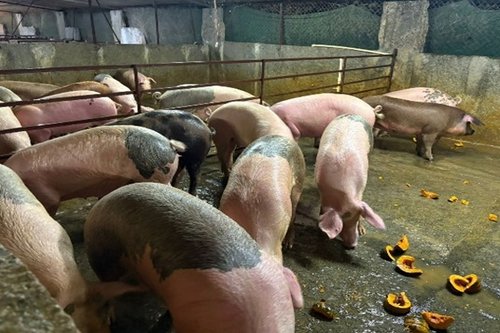
The cost of feeding the animals every day involves more than 50% of the cost of production. In India, pig rearing often relies on swill feeding methods combined with concentrate feeds. This approach allows marginal and small-scale stakeholders to run operations economically and achieve higher profitability. Mr. Subbareddy farm is located approximately 80 kms away from Bengaluru city. This farmer established an innovative symbiotic arrangement by securing agreements with hotels to collect their waste, which challenges and provides a sustainable source of feed for the animals. Every day 2 vehicles will collect hotel waste from the surrounding areas of Bangalore and mix it with some vegetable and fruit waste (fig -2) from the local market and shopping complexes followed by boiling for at least 30 min before feeding to the grower and finisher animals. During the breeding season, pregnant animals are only fed with a concentrated diet.
LABOUR MANAGEMENT
He never forgets to give credit to the people who are working hard for successful running of the farm. Running a pig farm isn’t easy and the local people still think pig farming is an unclean work so finding labourers nearby is tough, but still they have 5 labourers from Assam who have basic and yet essential knowledge about pig farming. To him, they are far more than just labourer’s; they are the fundamental reason the farm operates punctually and the shed remains flawless every day, possessing a deep familiarity with the animals’ sounds, habits, and the early indicators when something goes wrong.
MARKET FACILITIES
In Karnataka, pork consumption is restricted to only certain regions such as Kodagu, Mandya and surroundings. As a result, marketing the surplus production becomes a major challenge. Due to the absence of a well-established local market, finished pigs are primarily marketed through intermediaries to buyers located outside the state, particularly to the north – eastern region. Marketing of animals is carried out either individually or in bulk depending on specific requirements of the buyers. The prevailing live weight price is approximately Rs 120 per kg live weight, while weaners are marketed at 3 months age @ Rs. 6,000 per head in a local market as per the present scenario. However, the prices are subjected to seasonal fluctuations. Demand for pork generally reaches its peak during the month of December. Due to the absence of local farmer support organizations makes it very difficult to control the intermediaries and fluctuating prices.
CONSTRAINTS
According to the farmer, pig farming feels like gambling against the outbreaks of diseases. Even with all those biosecurity and hygienic environments it will be always haunting their mind that a little breach in the biosecurity will cost them a lot. Along this, major constraints they are facing in pig farming are funding by the government, lack of government-supported training programs, even though the pig farming in Karnataka is a growing agribusiness but still they feel the government is not giving enough attention. Due to hesitation of practitioners to treat pigs, it’s very hard to get the sick animals treated.
FUTURE PLANS
The farmer expresses a positive outlook toward the adoption of artificial insemination techniques, advanced technologies, including artificial intelligence for improved farm management. However, challenges such as the requirement of substantial capital investment and inadequate training to the farmers. Improved Access to government approved financial support, such as subsidized credit facilities and innovative livestock entrepreneurship platform would greatly facilitate future expansion and the integration of modern technologies.
SUGGESTION TO NEW ENTERPRENEURS
According to him Practice & Patience are the key for any business. Pig farming can yield higher returns compared to other livestock enterprises, provided that scientific management practices are followed. Prospective entrepreneurs are advised to invest sufficient time in acquiring technical knowledge and hands-on experience prior to establishing a unit. He also says that the establishment of a pig farm requires mandatory approval from the local Gram Panchayat and consent from the State Pollution Control Board. He encourages the youth to embrace innovative entrepreneurial ideas and establish new ventures, emphasizing that they will undoubtedly achieve success if they maintain patience and dedicate continuous effort.
CONCLUSION
The success story of Mr. Subbareddy demonstrates how pig farming has evolved into a sustainable and profitable enterprise through his dedication and hard work. His success is primarily due to his commitment towards the farm, spending 2-3 hrs everyday by supervising farm activities and continuous planning for future growth. Even in the absence of work he personally takes responsibility for managing the farm. His achievement highlights the importance of proper breed selection, efficient feeding strategies, breeding management, biosecurity measures and marketing. Along with the challenges such as disease outbreak, limited facilities from the government and marketing facilities which continue to exist. The farmer has overcome these through his determination and innovative approaches. This success story is an inspiration to new entrepreneurs and youths to take up pig farming as a profitable enterprise and contributing to the growth of the livestock sector in India. As emphasized by the farmer, ultimately success in this industry relies upon the integration of the 3P formula which is Practical experience, Patience and meticulous ongoing Planning.
REFERENCES
1.Department of Animal Husbandry and Dairying. (2019).20th livestock census -2019: All India Report. Ministy of Fisheries, Animal husbandry and Dairying Government of India.



Be the first to comment